
Power Washing vs Pressure Washing vs Soft Washing in Springfield MO — What’s the Difference?
Power Washing vs Pressure Washing in Springfield MO
Direct answer: If you’ve called around for exterior cleaning in Springfield and heard three different terms — “power washing,” “pressure washing,” and “soft washing” — you’re not alone. Most Springfield homeowners use them interchangeably. So do a surprising number of companies that do this work. They’re not the same thing. And using the wrong method on the wrong Springfield surface can cost you more than a dirty driveway — it can cost you a damaged roof, warped siding, or a void warranty on a $30,000 deck. This guide explains exactly what each method is, when it’s the right choice, and why Springfield’s specific climate makes the decision more important here than in most US markets.
THE THREE METHODS DEFINED
What Is Power Washing in Springfield MO?
Power washing uses high-pressure hot water — typically 1,500–4,000 PSI at temperatures up to 200°F — to remove heavy-duty contamination from hard surfaces. The combination of heat and pressure makes it particularly effective for removing grease, oil, industrial buildup, gum, and stubborn staining from commercial surfaces.
What power washing is right for in Springfield:
- Commercial kitchen exhaust areas
- Restaurant sidewalks with heavy grease
- Industrial facilities
- Fleet vehicle undercarriages
- Heavy oil staining on commercial concrete
What power washing is wrong for in Springfield:
- Residential siding (any type)
- Asphalt roof shingles
- Wood decks
- Standard residential driveways (hot water can damage sealants)
Warning: Most residential exterior cleaning companies in Springfield don’t actually use power washing — they use pressure washing and call it power washing because that’s what homeowners search for. The distinction matters when you’re evaluating what method a company is actually using on your property.
What Is Pressure Washing in Springfield MO?
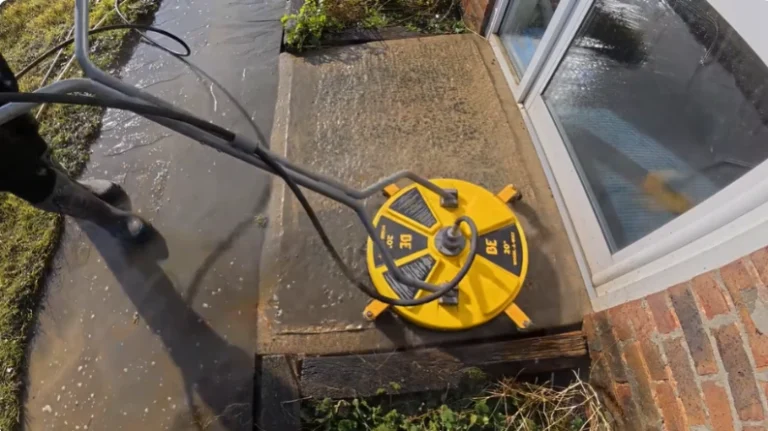
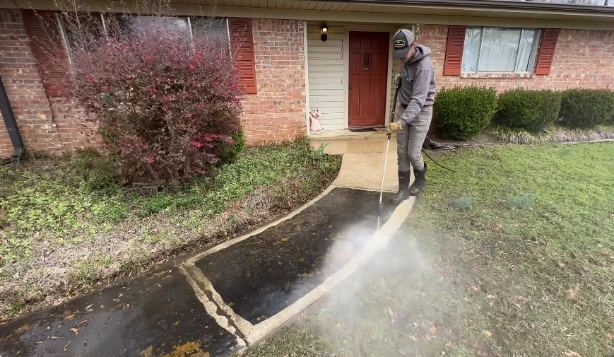
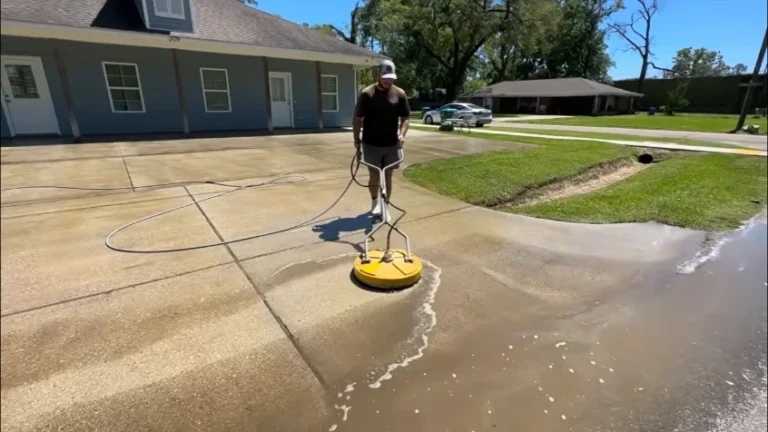
Pressure washing uses cold or ambient-temperature water at high pressure — typically 1,500–4,000 PSI — to mechanically remove surface contamination through force. No cleaning chemical is required, though detergents are sometimes added downstream.
What pressure washing is right for in Springfield:
- Concrete driveways and parking areas
- Concrete patios and sidewalks
- Block paving and pavers
- Exposed aggregate
- Brick hardscaping (at appropriate lower PSI)
- Pool surrounds and concrete surfaces
What pressure washing is wrong for in Springfield:
- Vinyl, Hardie board, painted wood, stucco, or cedar siding
- Asphalt shingle roofs
- Wood decks (at high PSI — lower-pressure washing is used)
- Painted decorative surfaces
Key limitation: The critical limitation of pressure washing: it removes surface-level contamination through mechanical force but does not kill biological organisms. Gloeocapsa Magma, green algae, mold, and mildew that live in the pores of concrete or within siding surfaces are physically disrupted but not killed. They re-establish from remaining spores within 4–8 weeks in Springfield’s humid climate. This is why Springfield homeowners who pressure wash their driveways themselves find the algae returns within a month or two.
What Is Soft Washing in Springfield MO?
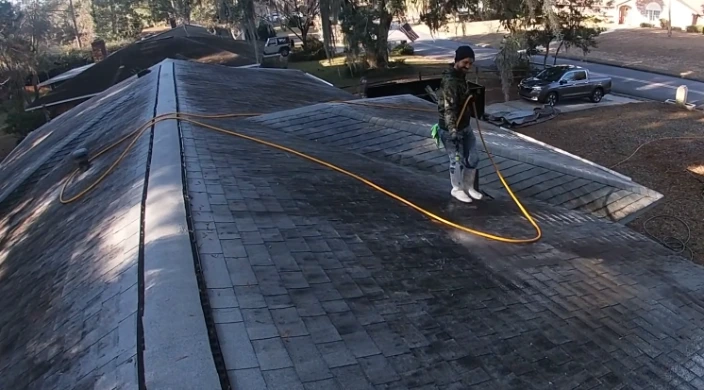
Soft washing uses very low water pressure — 250–500 PSI — combined with a cleaning solution (typically sodium hypochlorite at 1–2% concentration with a biodegradable surfactant) to kill and rinse away organic growth. The chemistry does the cleaning. The water delivers and rinses it.
What soft washing is right for in Springfield:
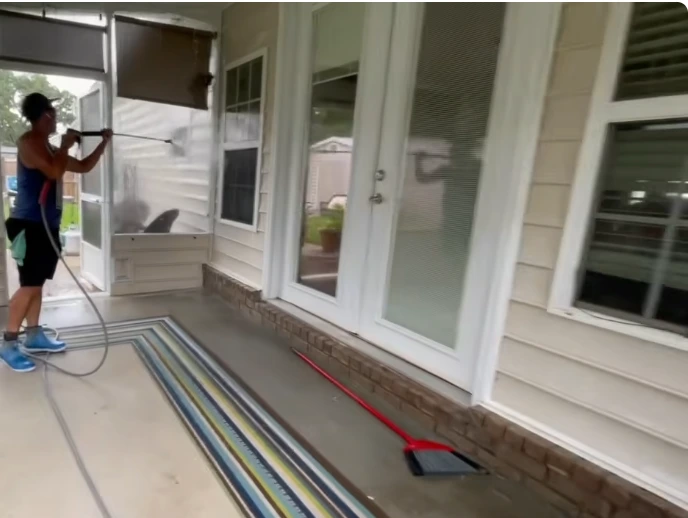
- Vinyl siding, Hardie board, brick, stucco, painted wood, cedar shake — all siding types
- Asphalt shingle roofs and metal roofs
- Wood decks, composite decks, vinyl decks
- Fences (wood and vinyl)
- Gutters and soffits
- Any surface where high-pressure contact would cause damage
Why soft washing outperforms pressure washing for Springfield siding and roofs:
- It kills the organism. Sodium hypochlorite at 1.5–2% kills Gloeocapsa Magma, green algae, mold, and mildew at the cellular level. The organism is dead — not relocated. Results last 12–24 months in Springfield’s climate.
- It’s safe for every siding material. 250–300 PSI cannot force water behind siding panels, strip oxidation layers, or damage aged vinyl. Every siding manufacturer recommends low-pressure washing for exterior maintenance.
- It reaches where pressure can’t. The cleaning solution penetrates the microscopic pores and gaps where biological growth lives. Mechanical pressure only affects what it can physically hit.
Not sure which method your siding, roof, or deck needs? Use the decision matrix below to match every common Springfield surface to its correct method.
THE SPRINGFIELD DECISION MATRIX
Which Method Is Right for My Springfield Home?
Use this table to match your surface to the correct method:
| Surface | Correct Method | PSI Range | Why |
|---|---|---|---|
| Concrete driveway | Pressure washing | 2,500–3,500 | Hard surface, can handle mechanical cleaning |
| Stamped/decorative concrete | Pressure washing (lower) | 1,500–2,000 | Same as concrete but protect texture |
| Pavers/brick hardscape | Pressure washing | 1,200–2,000 | Preserve jointing sand and mortar |
| Vinyl siding | Soft washing | 250–300 | High pressure causes water intrusion and oxidation |
| Hardie board siding | Soft washing | 250–300 | High pressure damages factory-cut seams |
| Brick exterior | Soft washing | 250–400 | High pressure erodes mortar joints over time |
| Stucco | Soft washing | 200–250 | Extremely vulnerable to surface erosion |
| Cedar shake | Soft washing | 250–300 | Soft grain damages easily under pressure |
| Painted wood siding | Soft washing | 250–300 | High pressure lifts paint |
| Asphalt shingle roof | Soft washing | 100–300 | High pressure strips granules — destroys shingles |
| Metal roof | Soft washing | 250–400 | Avoid high pressure at seams and fasteners |
| Wood deck | Low-pressure wash | 500–800 | Wood-specific chemistry + lower PSI |
| Composite deck | Soft washing | 1,000–1,500 | Manufacturer spec — high pressure voids warranty |
| Vinyl fence | Soft washing | 250–300 | Same as vinyl siding |
| Wood fence | Low-pressure wash | 500–800 | Wood-specific chemistry required |
Not Sure Which Method Your Springfield Home Needs?
Tell us your surface and we’ll recommend the right method — in a free written quote, before we touch anything.
Get a Free Written Quote
Call 877-302-9335
Mon–Sat 7:00 AM–6:00 PM · Sunday Closed
WHY THE METHOD MATTERS MORE IN SPRINGFIELD
Does Springfield’s Climate Make Method Choice More Important Than in Other Cities?
Yes — for three specific reasons:
Reason 1: Springfield’s humidity means biological growth re-establishes fast.
If you use high-pressure washing on siding or a driveway and don’t kill the organism, Springfield’s year-round humidity above 73% provides the exact conditions Gloeocapsa Magma and green algae need to re-establish within weeks. Soft washing kills the organism. The results last 12–24 months. High-pressure results last 4–8 weeks — then you’re back where you started.
Reason 2: Springfield has diverse housing materials across its neighborhoods.
Springfield’s housing stock spans 80+ years of construction — 1940s brick homes in midtown, 1970s vinyl ranch houses in north Springfield, 1990s cedar shake in established subdivisions, and 2010s Hardie board in Battlefield and Republic-area new construction. Each material requires a different method and PSI. A company using one approach on everything will inevitably damage one type while cleaning another.
Reason 3: Freeze-thaw cycles make surface damage more serious.
Any surface damage created by wrong-method cleaning — micro-cracks from excessive pressure on concrete, surface erosion on brick mortar, gaps forced into vinyl panels — becomes a freeze-thaw entry point in Springfield’s winters. Water enters the damaged area, freezes, expands 9%, and widens the damage. Surface damage from incorrect pressure washing compounds over Missouri winters in a way it doesn’t in warmer climates.
WHAT TO ASK BEFORE HIRING
How Do I Know if a Springfield Pressure Washing Company Is Using the Right Method?
Ask these four questions before booking any exterior cleaning company in Springfield:
- “Do you soft wash siding or pressure wash it?” Correct answer: soft wash. Any company applying 1,500+ PSI to vinyl or Hardie board siding is using the wrong method.
- “What PSI do you use on roofs?” Correct answer: under 300 PSI. Any company applying high pressure to asphalt shingles is stripping granules that protect your roof.
- “Do you apply post-treatment after cleaning?” Correct answer: yes — algicide or mold inhibitor on all organic-growth surfaces. Companies that skip this step get results that last 4–6 weeks in Springfield’s climate.
- “Do you provide a written quote before starting?” Correct answer: yes. Verbal estimates that change when the company arrives are a red flag.
We answer all four the right way on every job — soft wash on siding and roofs, under 300 PSI on shingles, post-treatment algicide as standard, and a free written quote before we start.
Power Washing vs Pressure Washing vs Soft Washing: Springfield Questions, Answered
Frequently Asked Questions
Get the Right Method for Your Springfield Home
Soft wash safe on siding and roofs. $2M insured. Written quote before we touch anything — the quote we send is the price you pay.
Get a Free Written Quote
Call 877-302-9335
Mon–Sat 7:00 AM–6:00 PM · Sunday Closed