
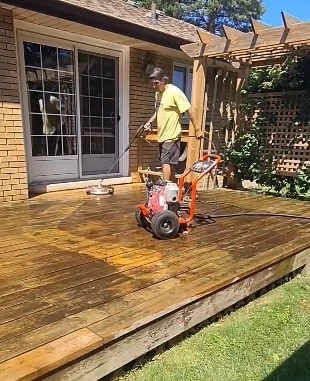
Deck & Patio Cleaning · Springfield MO · Greene County
Deck Pressure Washing Springfield MO — The Right Method for Every Deck Material
Springfield’s humidity never gives your deck a break. We use wood-specific chemistry, correct dwell time, and the right PSI for your deck material — so you get a clean that lasts, not one that warps your boards or voids your stain warranty.
✅ $2M Insured
📋 Written Quote Before We Start
🪵 Wood-Safe Chemistry
🛡️ Staining Prep Included
The Springfield Deck Problem
Why Do Springfield Decks Gray and Deteriorate Faster Than They Should?
Springfield sits in a humid subtropical climate zone with year-round humidity that rarely drops below 73%. Your deck wood never fully dries between rain events — it absorbs moisture, swells, then dries and contracts under Missouri’s summer sun. This constant expand-and-contract cycle breaks down surface wood fibers from the outside in.
Meanwhile, mold and mildew spores — always airborne in the Ozarks — find those damp, warm wood fibers and colonise the grain. The gray color you’re seeing isn’t aging. It’s UV damage combined with mold penetration working together to degrade your deck surface.
Ozark hardwood trees drop tannin-heavy leaves and sap that stain wood with a dark, iron-like discoloration that regular cleaning won’t touch. Springfield’s 46+ inches of annual rainfall keeps organic material wet long enough to set into the surface. The result: Springfield decks look five years older than they are.
🌧️ 73%+ Year-Round Humidity
Springfield’s wood never fully dries between rain events. Constant moisture creates ideal conditions for mold and mildew to colonise deck grain year-round.
🌳 Ozark Tannin Staining
Oak, maple, and sweet gum trees drop tannin-heavy leaves and sap that stain wood surfaces dark brown. Standard pressure washing doesn’t touch it — oxalic acid is required.
☀️ 230+ Sunny Days per Year
Missouri UV radiation oxidises wood lignin, turning surfaces gray. This isn’t aging — it’s a chemical change that oxalic acid brightener reverses, restoring natural wood colour before staining.
The Biology
What Is the Black and Green Buildup on My Springfield Deck?
Most Springfield homeowners call it “mold” and treat it as a single problem. It’s actually several distinct organisms living in layers — each requiring a different approach to eliminate properly.
🟢
Green Algae
The bright green slick film on horizontal surfaces. A genuine slip hazard when wet. Ozark tree coverage keeps Springfield decks shaded and damp — ideal algae conditions. Accelerates wood decay by retaining moisture against the surface.
⚫
Black Mold & Mildew
Penetrates the wood grain itself rather than sitting on the surface. Springfield’s year-round humidity keeps wood moisture content high enough for mold to thrive. Can’t simply be blasted off — requires chemical treatment that kills at the root.
🦠
Gloeocapsa Magma
The same cyanobacteria causing black streaks on roofs — can colonise wood surfaces in Springfield. Feeds on organic material in wood fibers and spreads via airborne spores. Springfield’s humid climate makes it a year-round threat.
🍂
Tannin Staining
Dark, rust-coloured streaks from oak, maple, and sweet gum trees — which dominate Springfield neighborhoods. Penetrates the wood deeply. Requires an oxalic acid brightener, not just pressure alone.
☀️
UV Gray Weathering
UV radiation from Missouri’s 230+ sunny days oxidises the lignin in wood fibers, turning them gray. Not aging — it’s a chemical change. Good news: oxalic acid brightener reverses gray weathering and restores natural wood color before staining.
Material-Specific Treatment
Does the Type of Deck Affect How It Should Be Pressure Washed?
Absolutely — using the wrong method on the wrong material is the most expensive mistake Springfield homeowners make. Here is exactly how we approach each deck type.
🪵 Treated Pine
Most common in Springfield & Greene County
PSI: 500–800 · 15-degree tip · Dwell time: 5–8 minutes. Wood-specific cleaner (not bleach). Oxalic acid brightener after rinsing. Never use bleach — it degrades lignin and causes premature graying.
🌲 Cedar & Redwood
Softer grain — lower PSI required
PSI: 500–600 max · 25-degree tip. Reduced cleaner concentration. Cedar feathers easily at wrong pressure. Always rinse with the grain, never against it.
🏗️ Composite (Trex, TimberTech)
Soft wash only — warranty requirement
Max 1,500 PSI · Fan tip 12″+ from surface · 0.5–1% SH solution between boards. Never use turbo nozzle — removes protective cap layer permanently. Common in Battlefield, Republic, south Springfield.
🤍 Vinyl Decking
Soft wash only — chemistry does the work
250–300 PSI maximum. 1–1.5% sodium hypochlorite solution. High pressure on vinyl causes micro-scratching that accelerates future staining. The cleaning solution does the work — pressure just rinses.
🌴 Hardwood (Ipe, Teak)
Higher-end Springfield & Battlefield properties
Extremely dense grain — dwell time 8–10 minutes. Oxalic-based cleaner only — bleach causes severe damage to tropical hardwoods. Careful chemical selection critical.
What to Avoid
5 Deck Pressure Washing Mistakes We See on Springfield Decks
Every one of these creates damage that’s visible for the life of the deck. We fix the results of these mistakes on jobs every week in Springfield.
❌ Mistake 1: Not Pre-Wetting the Wood
Applying chemical to dry wood means it absorbs unevenly — heavy in some spots, light in others. Patchy, inconsistent results. Wet wood first: the water inside the grain prevents chemical from over-penetrating, so you clean the surface, not the interior of the board.
❌ Mistake 2: Using Bleach on Wood
Bleach degrades lignin — the structural component holding wood fibers together — causing premature graying, raised grain, and brittleness. Bleach is right for concrete, siding, and roofs. On wood, it’s destructive. Use wood-specific cleaners formulated for the grain structure.
❌ Mistake 3: Wrong PSI for the Material
A 3,000 PSI machine on treated pine leaves furry, raised grain that can’t be sanded smooth — a deck that won’t accept stain because the surface is damaged. Start low, move higher if organic growth isn’t lifting. You can always increase pressure. You can’t reverse a gouged board.
❌ Mistake 4: Wrong Dwell Time
Rinsing immediately before the chemical kills the organism = temporary cleaning that returns in 4 weeks. Leaving it too long = streaking. Correct dwell time is 5–10 minutes for most Springfield wood decks. When you see natural wood color returning, dwell time is correct.
❌ Mistake 5: Inconsistent Wand Control — Tiger Striping
Moving the wand inconsistently creates alternating light and dark bands across deck boards. This is permanent — cannot be sanded out without reshaping the board. Correct technique: start at the top, maintain consistent speed and distance, move top to bottom in one pass. Never stop mid-board.
Before You Stain
Does My Deck Need to Be Cleaned Before Staining?
Yes — without exception. Staining a dirty deck is one of the most common and expensive mistakes Springfield homeowners make. The result is always the same: the stain peels within one season.
Stain adhesion depends on the wood’s ability to absorb the product into clean, open grain. When mold, algae, gray weathering, and tannin staining are present, the wood’s pores are blocked. The stain sits on top of the contamination. It looks good for 30 days. Then it peels.
Most deck stain manufacturers require professional cleaning as a prerequisite for warranty coverage. Stain applied to a properly cleaned and brightened surface lasts 2–3× longer than stain on an unprepped surface.
Our Staining Prep Sequence:
- Pre-wet all surfaces and surrounding landscaping
- Apply wood-specific cleaner at correct concentration for your deck material
- Allow correct dwell time (5–10 minutes)
- Rinse thoroughly — grain-direction only
- Apply oxalic acid brightener — neutralises pH, restores natural wood colour
- Allow 48–72 hours drying time before stain application (Springfield humidity extends this)

💡 Springfield-Specific Note
Springfield’s year-round humidity above 73% means your deck needs the full 72-hour drying window before stain. Don’t rush this. Staining damp wood traps moisture and causes bubbling — especially on north-facing decks that stay shaded.
Our Process
The Correct Deck Pressure Washing Process in Springfield MO
No shortcuts. No guesswork. Every Springfield deck job follows this exact sequence — documented and photographed before we start.
01
Pre-Inspection & Written Quote
Deck material, condition, staining history, and what’s growing on it are inspected before quoting. Pre-existing damage is photographed and documented. Written quote before we start — no surprises.
02
Pre-Wet All Surfaces
Surrounding landscaping, deck boards, and railings are pre-soaked with water. Protects plants from cleaning solution and ensures even chemical distribution across the deck surface.
03
Wood-Specific Cleaner Application
The right cleaner for your specific deck material at the correct concentration. Treated pine: wood cleaner at medium concentration. Composite: soft wash at 0.5–1%. Never bleach on any wood surface.
04
Correct Dwell Time (5–10 Minutes)
We wait. This is the step DIY cleaners skip — and it’s why professional results last 12+ months while a DIY clean returns in 4 weeks. Dwell time kills the organism at cellular level, not just removes its surface appearance.
05
Rinse at Correct PSI
Material-specific PSI, consistent wand control, grain-direction passes top to bottom. Fan tip for all wood surfaces. Turbo nozzle only on composite if manufacturer permits.
06
Oxalic Acid Brightener
Applied after rinsing. Neutralises the cleaning solution pH, reverses gray UV weathering, and restores natural wood colour. Essential for staining prep. Visible results within minutes of application.
07
Post-Treatment Algicide
Algicide and mold inhibitor applied to all treated surfaces. Not standard at other Springfield companies — included in every job we do. Extends results to 12–18 months instead of 4–6.
Real Results
Real Springfield Deck Cleaning Results
Three completed Springfield jobs — different materials, different problems, same documented process.
Republic MO · Treated Pine
Pre-Staining Prep — 480 sq ft
3 seasons of buildup, heavy black mold in grain, planning to restain
The homeowner had purchased a stain and was ready to apply it. When we arrived, the deck had heavy black mold in the grain, green algae on all horizontal surfaces, and gray UV weathering across every board. Their penetrating oil stain would have been completely rejected by the blocked grain. Full staining prep: wood cleaner, 8-minute dwell, oxalic acid brightener. Natural wood colour — warm honey tone — visible within minutes.
“The wood looks like it did when we built the deck 6 years ago. The stain went on perfectly and is still holding 18 months later.”
— K. & T. Barlow, Republic MO
Battlefield · Composite Trex
Algae Between Boards — 320 sq ft
Green algae between boards — homeowner had tried a 3,000 PSI rental machine
The rental machine moved algae around — the algae between deck boards hadn’t been touched. It requires soft wash solution to penetrate the gap, not high-pressure water. We soft washed at 1,200 PSI with 0.8% SH solution specifically for composite, penetrating the gaps and killing the algae colony at the root. Post-treatment algicide applied. Fourteen months later: no visible regrowth.
“The rental machine just moved it around. These guys explained why the algae kept coming back and actually fixed the source. Over a year and the deck still looks clean.”
— M. Whitfield, Battlefield MO
South Springfield · Cedar
Deck + Fence Bundle — Tannin Staining
260 sq ft cedar deck + 80 linear feet cedar fence, heavy tannin staining under white oak
Tannin staining from a large white oak had turned the cedar almost black in places. Standard pressure washing hadn’t touched it. Tannin staining requires oxalic acid, not water pressure. Cedar-appropriate wood cleaner followed by oxalic acid brightener on all stained areas. Natural cedar colour — warm reddish-brown — visible across the entire surface after treatment.
“I thought we were going to have to replace the deck. The tannin staining looked permanent. I couldn’t believe what the oxalic acid treatment did — it looked brand new.”
— R. Ochoa, South Springfield
FAQ
Frequently Asked Questions — Deck Pressure Washing Springfield MO
How much does deck pressure washing cost in Springfield MO?
Deck pressure washing cost in Springfield, MO depends on deck size, with staining prep (oxalic acid brightener) available as an add-on. Full property packages including house washing and driveway are also available. Written quote before any work begins.
Can you pressure wash a composite deck in Springfield MO?
Yes, but composite decks require soft washing — not high-pressure washing. Maximum 1,500 PSI with a fan tip held at least 12 inches from the surface. Most composite manufacturers (Trex, TimberTech, Azek) require soft washing in their warranty terms. A sodium hypochlorite solution at 0.5–1% concentration effectively removes algae and mold without surface damage.
Does pressure washing damage deck wood in Springfield?
Pressure washing at the wrong PSI with the wrong technique damages deck wood — but professional deck washing at correct settings does not. Wrong pressure creates tiger striping (permanent bands from inconsistent wand speed) or fuzzy raised grain. We use material-specific PSI settings: 500–800 for treated pine, lower for cedar, soft wash only for composite.
Should I clean my deck before staining in Springfield MO?
Yes — without exception. Staining a dirty deck seals mold, algae, and tannin staining under the finish, preventing proper penetration and causing the stain to peel within one season. The correct prep sequence is: wood cleaner + correct dwell time + rinse + oxalic acid brightener + 48–72 hours drying time. Springfield’s humidity may require the longer end of the drying window.
How often should I have my deck pressure washed in Springfield Missouri?
Most Springfield decks benefit from annual cleaning — spring (April–May) before peak algae season is ideal. Decks under heavy Ozark tree canopy or north-facing may need cleaning every 6–9 months. Springfield’s year-round humidity above 73% means mold and algae regrow faster than in drier climates. Post-treatment algicide extends results to 12–18 months.
Can you clean a deck and fence together in Springfield?
Yes — we bundle deck and fence cleaning frequently.Fence washing in Springfield MO is most efficient bundled with a deck job — same chemistry, same visit Cedar and wood fences benefit from the same wood-specific process. Bundling deck and fence work depends on square footage and linear footage. Both surfaces receive post-treatment algicide as standard.
Do I need to be home when you clean my deck in Springfield MO?
No — most Springfield homeowners aren’t home during the service. We need access to your backyard through a gate or side access, and an exterior water spigot. Pets should be kept indoors. We send before-and-after photos when the job is complete. Written pre-inspection report is sent before work begins.

Get a Free Written Quote for Your Springfield Deck
No guesswork. Written quote before we touch anything. Most Springfield homeowners hear back within 2 hours.
Serving Springfield · Nixa · Ozark · Republic · Battlefield · Rogersville · Willard · Greene County
✅ $2M Insured
📋 Written Quote First
🪵 Wood-Safe Chemistry
🛡️ Post-Treatment Algicide Standard
Related services: House Washing · Driveway Cleaning · Back to Homepage