Why Mold and Algae Grow So Fast on Springfield MO Homes — The Full Science
Why Mold and Algae Grow So Fast on Springfield MO Homes
Direct answer: Springfield, MO homes develop mold and algae faster than most Midwest cities because of three compounding climate factors: year-round humidity averaging 73–77% (the EPA’s mold germination threshold is 60%), 46+ inches of annual rainfall that keeps surfaces consistently wet, and dense Ozark tree canopy that extends shaded dampness long after rain events. The primary organism is Gloeocapsa Magma, a cyanobacteria that spreads via airborne spores and feeds on exterior building materials.
If you’ve lived in Springfield long enough, you’ve noticed it: the driveway you cleaned last spring is green again. The siding that looked good in April has black streaks by July. The deck that was clear after washing is already showing mold in the grain by September. This isn’t poor maintenance. It’s not inferior materials. It’s Springfield’s climate doing exactly what it does, to every exterior surface, in every Greene County neighborhood, year after year. Understanding why this happens is the first step to stopping the cycle. This article explains the complete science — the organisms involved, the climate factors that drive them, and what actually creates lasting protection on Springfield home exteriors.
THE PRIMARY ORGANISM
What Is Gloeocapsa Magma and Why Is It All Over Springfield Homes?
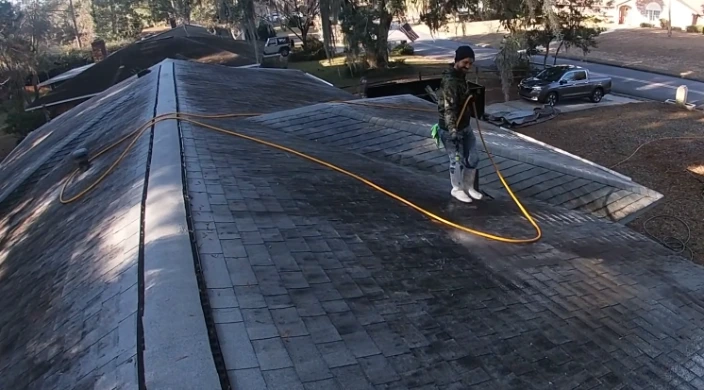
Gloeocapsa Magma is a cyanobacteria — technically a photosynthetic bacterium rather than a true algae — that is the single most common cause of dark staining on Springfield home exteriors, particularly on roofs and siding. The Asphalt Roofing Manufacturers Association (ARMA) specifically identified Gloeocapsa Magma as the primary biological cause of the dark streaking seen on asphalt roofs across the United States. The organism is not new — it’s been present in the environment for millions of years — but it has expanded its range northward and inland from the US Gulf Coast over the past four decades as humid conditions have become more widespread.
How Gloeocapsa Magma works:
The organism feeds on the calcium carbonate limestone filler used in asphalt shingle manufacturing. It also colonizes the calcium-containing components in concrete, stucco, and painted surfaces. As colonies grow, they produce a dark-colored protective sheath around their cellular clusters — this sheath is what creates the visible black streaking. The sheath protects the bacteria from UV radiation, which would otherwise kill surface-level colonies. This is important because it explains why pressure washing temporarily removes the visible staining but doesn’t solve the problem. The sheath material — essentially dead and shed bacterial cells — washes off. The live colony underneath survives. By the following season, it has produced a new sheath layer, and the streaking returns.
How it spreads:
Gloeocapsa Magma spreads via airborne spores. A single infected Springfield roof releases spores that travel on prevailing winds to neighboring properties. This is why, in established Springfield neighborhoods, you’ll often see Gloeocapsa Magma appearing on multiple roofs on the same street within a 2–3 year period after it appears on one. Springfield’s wind patterns during spring storm systems carry spores from infected properties broadly across Greene County. Once spores land on a surface with appropriate conditions — moisture, shade, calcium-containing substrate — they establish within one growing season.
What kills it:
Sodium hypochlorite at 1.5–2% concentration is the accepted biocidal treatment for Gloeocapsa Magma on exterior surfaces. Applied at low pressure (soft washing), the solution kills the organism at the cellular level. The dead colony material is then rinsed away. With post-treatment algicide applied after cleaning, the conditions for immediate re-colonization are disrupted for 12–24 months.
THE SECONDARY ORGANISMS
What Other Types of Mold and Algae Grow on Springfield Homes?
Green algae (Chlorophyta) — The bright green film most visible on Springfield driveways, patios, and horizontal surfaces. Green algae requires liquid water (not just humidity) to establish, making it more dependent on Springfield’s rainfall than Gloeocapsa Magma. It colonizes shaded, perpetually damp surfaces — north-facing driveways, surfaces under dense Ozark tree coverage, and areas near downspout discharge. Green algae creates a genuinely slippery biofilm when wet — a real slip hazard on driveways and walkways. It does not produce the same dark sheath as Gloeocapsa Magma and is typically more responsive to pressure washing alone than the cyanobacteria, but without post-treatment it re-establishes from spores within the same season.
Black mold and mildew (Cladosporium, Alternaria, and related species) — True mold species colonize the grain of wood surfaces — decks, fences, wood siding — rather than sitting on mineral surfaces like concrete or shingles. Springfield’s constant humidity provides the moisture content these organisms need. Mold penetrates wood grain and cannot be removed by pressure washing — it requires a chemical treatment that kills the organism within the fiber. The visible gray-black discoloration on Springfield wood decks is typically a combination of mold penetration and UV-induced lignin oxidation (gray weathering). Both require treatment, but different approaches: mold requires a wood-specific cleaner or sodium hypochlorite dilution, while gray weathering requires an oxalic acid brightener.
Moss (Bryophyta) — Common on Springfield driveways and walkways under heavy tree coverage — particularly in Ozark MO’s river valley and in heavily canopied midtown Springfield neighborhoods. Moss requires consistently high moisture and shade to establish and holds water against concrete surfaces, accelerating freeze-thaw damage. It’s thicker and more structurally established than algae — requiring longer chemical dwell time to kill before removal.
Lichen — Less common than the above but found on older Springfield brick and concrete surfaces. Lichen is a symbiotic combination of algae and fungi that is extremely resistant to removal — it attaches to mineral surfaces with root-like structures called rhizines. Once established, lichen requires specific chemical treatment and extended dwell time. Pressure washing alone won’t remove established lichen without permanently damaging the surface underneath.
Dealing With Mold or Algae on Your Springfield Home?
Soft washing kills Gloeocapsa Magma, mold, and algae at the cellular level — plus post-treatment algicide to keep them from coming back. Get a free written quote.
Get a Free Written Quote
Call 877-302-9335
Mon–Sat 7:00 AM–6:00 PM · Sunday Closed
THE SPRINGFIELD CLIMATE FACTORS
Why Does Springfield Missouri Have Such Bad Exterior Mold and Algae Problems?
Springfield’s position in the Missouri Ozarks creates a convergence of climate factors that collectively produce one of the most challenging exterior maintenance environments in the Midwest.
Factor 1: Humid Subtropical Classification — Springfield is classified as a humid subtropical climate (Köppen Cfa) — the same climate zone as cities in the US South including Atlanta, Memphis, and Charlotte. This classification means warm, humid summers with no dry season. The entire year maintains elevated humidity, not just summer months. The EPA notes that mold germinates and spreads at relative humidity above 60%. Springfield’s average relative humidity is 73–77% year-round, with monthly averages never falling below 68% even in the driest months. Springfield exterior surfaces are never in conditions hostile to mold and algae growth for any extended period.
Factor 2: 46.5 Inches of Annual Rainfall — Springfield averages 46.5 inches of annual rainfall — 21% above the US national average of 38.6 inches. This rainfall is distributed throughout the year rather than concentrated in a wet season, meaning surfaces receive consistent moisture exposure across all seasons. Importantly, Springfield’s spring rainfall (March–May) is particularly heavy — coinciding with the primary algae growth season when temperatures are rising and organic growth is accelerating. Spring rain deposits layers of pollen, organic debris, and moisture on exterior surfaces that become the nutrient base for summer algae colonization.
Factor 3: Ozark Tree Canopy — Springfield sits within the Ozark Highlands, a region characterized by dense hardwood forest coverage — primarily white oak, red oak, sugar maple, hickory, and sweet gum. Springfield’s urban and suburban neighborhoods retain significant tree coverage from this hardwood ecosystem. This canopy creates prolonged shade on exterior surfaces after rainfall. A Springfield driveway in direct sun may dry within 2–3 hours of rain. The same driveway under mature oak coverage may remain damp for 12–18 hours — or longer during Springfield’s extended cloudy periods in spring. That extended wet period is the difference between conditions that support algae and conditions that don’t. Canopy trees also deposit continuous organic material — pollen, leaf fragments, sap, insect honeydew — onto exterior surfaces. This organic debris feeds algae colonies and provides adhesion material that helps spores establish on otherwise smooth surfaces.
Factor 4: 16–20 Annual Freeze-Thaw Cycles — Springfield’s winters are cold enough to freeze but warm enough to thaw repeatedly — averaging 16–20 freeze-thaw cycles per winter. This creates a specific structural threat for exterior surfaces with established organic growth. Organic growth on concrete retains moisture against the surface. When temperatures drop below freezing, that trapped moisture expands by 9% as it freezes, widening micro-cracks and fracturing concrete from within. The following spring, those widened cracks provide deeper colonization sites for the next generation of organic growth. Over years, this cycle produces the pitting, spalling, and cracking that ultimately requires concrete replacement.
Factor 5: Springfield’s Geographic Position in the Midwest — Springfield’s position at the convergence of cold Canadian air from the north and warm Gulf moisture from the south creates frequent storm systems with high moisture content. These systems deposit significant moisture across Springfield and Greene County in concentrated events — extended spring rains that keep exterior surfaces wet for days at a time.
WHAT ACTUALLY STOPS IT
How Do You Prevent Mold and Algae on Springfield Home Exteriors?
What doesn’t work:
- Consumer pressure washing without chemical treatment — removes surface appearance, doesn’t kill organism, returns within weeks
- Bleach applied without soft washing technique — damages wood and painted surfaces when applied at high concentration or with high pressure
- DIY algae sprays from hardware stores — concentration too low for established colonies, no professional-grade post-treatment
What works:
Professional soft washing with sodium hypochlorite kills Gloeocapsa Magma, green algae, mold, and mildew at the cellular level. Applied at 1.5–2% concentration with correct dwell time (5–10 minutes for siding, 10–15 minutes for roofs), it eliminates the organism — not just its surface appearance. Learn the difference between methods in our guide to power washing vs pressure washing vs soft washing.
Post-treatment algicide applied after cleaning disrupts conditions for immediate re-colonization. Professional-grade algicide penetrates porous concrete and creates a temporary hostile environment for spore germination. In Springfield’s conditions, this extends clean results from 4–6 weeks (no treatment) to 12–18 months (with treatment).
Annual maintenance before organic growth re-establishes is more effective than periodic deep cleaning after years of accumulation. The organism is easier and cheaper to address in its first year than after 3–5 years of compounding colonization. See our guide on how often to pressure wash your Springfield home.
Trimming overhanging branches reduces the shade footprint that extends surface damp periods. Every square foot of shade removed is surface area that dries faster after rain — and surface area that’s less hospitable to algae.
Mold and Algae on Springfield Homes: Science Questions, Answered
Frequently Asked Questions
Stop the Regrowth Cycle for Good
Kill the organism, not just the stain — soft washing with post-treatment algicide keeps your siding, roof, and driveway clean for 12–24 months. Get your free written quote today.
Get a Free Written Quote
Call 877-302-9335
Mon–Sat 7:00 AM–6:00 PM · Sunday Closed